
Open Science Desktop

AI research tool list

Best Claude Science alternatives for AI research workbenches

The right Claude Science alternatives depend on what you mean by “science”: local files and code, browser research workspaces, literature review, evidence synthesis, or academic search. This list groups the strongest AI research workbench alternatives by the job they are built to do.
Open Science Desktop 7 min read
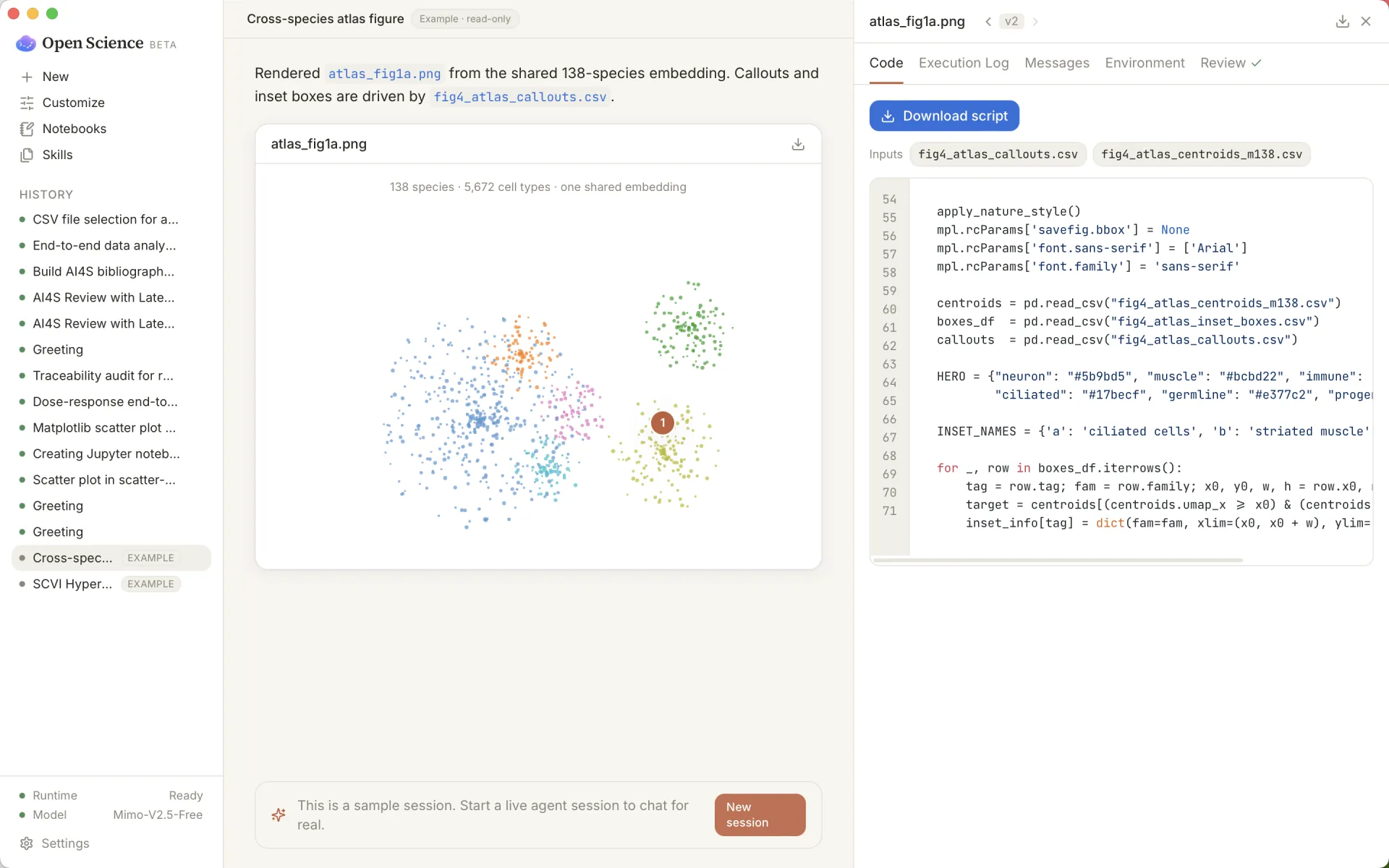
Open Science Desktop artifact view showing research evidence, code, and provenance

Short answer

Choose Open Science Desktop if you want a local-first, open-source desktop workbench for research files, code, notebooks, figures, and reproducible artifacts. Choose a browser or literature-review product if your main task is paper discovery, evidence screening, or hosted collaboration.

How to choose an AI research tool

“Best AI research tools for scientists” is too broad unless the workflow is explicit. A scientist writing code against local data needs a different product from a reviewer screening thousands of papers. Use these criteria before comparing names:

  • Surface: desktop app, browser workspace, CLI, or hosted search product.
  • Primary job: local analysis, literature review, citation search, systematic review, or agent workflow.
  • Data posture: local-first files, cloud workspace, or managed evidence database.
  • Auditability: whether outputs stay linked to code, sources, model context, and human review.
  • Extensibility: open source, SDK, plugins, MCP, or closed hosted workflow.

Claude Science alternatives by use case

1. Open Science Desktop

Local desktop workbench

Open Science Desktop is for researchers who want local project folders, desktop installation, model-agnostic providers, and reproducible artifacts. It is the strongest fit when the work involves private files, code-backed analysis, notebooks, figures, and reports that need provenance.

Best for: local AI research workbench, open source AI research assistant, Windows/macOS/Linux desktop users.

2. Synthetic Sciences OpenScience

Browser workspace + CLI

OpenScience is an open-source research-agent workflow launched from npm or npx into a browser workspace. It is closer to a browser-based agent environment than a traditional desktop app.

Best for: CLI-driven research loops, browser workspace, open-source agent workflow.

3. PaperGuide

Research writing + papers

PaperGuide focuses on paper discovery, reading, reference management, writing assistance, and research workflow features. It is more paper-centric than local-code-centric.

Best for: AI literature review tools, reference workflows, research writing support.

4. Elicit

Evidence synthesis

Elicit is built around finding papers, extracting structured information, and supporting evidence synthesis workflows. It fits researchers whose bottleneck is screening and summarizing literature.

Best for: systematic review support, evidence tables, literature extraction.

5. SciSpace

Literature assistant

SciSpace is a literature-focused AI assistant for discovering, reading, explaining, and working with research papers. It is useful when the research task starts with papers rather than local code or datasets.

Best for: paper explanation, literature discovery, reading assistance.

6. Consensus

Academic search

Consensus is centered on search across scientific literature and answers grounded in papers. It fits question-answering and quick evidence discovery better than local project execution.

Best for: academic search, evidence-backed answers, paper discovery.

7. OpenScholar

Open research model

OpenScholar is an open research-oriented model and system direction rather than a desktop workbench. It matters for teams looking at open approaches to literature-grounded scientific question answering.

Best for: open scientific QA research, model evaluation, literature-grounded answers.

Quick comparison

Tool Primary surface Choose it when
Open Science Desktop Desktop app You need local files, code-backed analysis, reproducible artifacts, and open-source desktop support.
OpenScience Browser workspace + CLI You want an npm-launched research-agent workspace.
PaperGuide Hosted paper workflow You want paper discovery, reading, reference, and writing workflows.
Elicit Hosted evidence synthesis You need extraction and synthesis across papers.
SciSpace Hosted literature assistant You need help finding, reading, and explaining papers.
Consensus Academic search You need evidence-backed answers from scientific literature.
OpenScholar Open research model/system You care about open literature-grounded scientific QA research.

Where Open Science Desktop fits

The gap Open Science Desktop targets is specific: researchers who want an AI workbench close to their local files and code, not only a browser search product. That is why the strongest positioning is not “another AI paper summarizer.” It is local-first, model-agnostic AI research workbench for macOS, Windows, and Linux.

For search, this page should compete for broader list queries. The deeper companion article targets Claude Science desktop alternative, local first Claude Science alternative, and open source Claude Science Windows.

Sources checked

Product positioning was checked against the official pages for Open Science Desktop, OpenScience, PaperGuide, Elicit, SciSpace, Consensus, and OpenScholar.